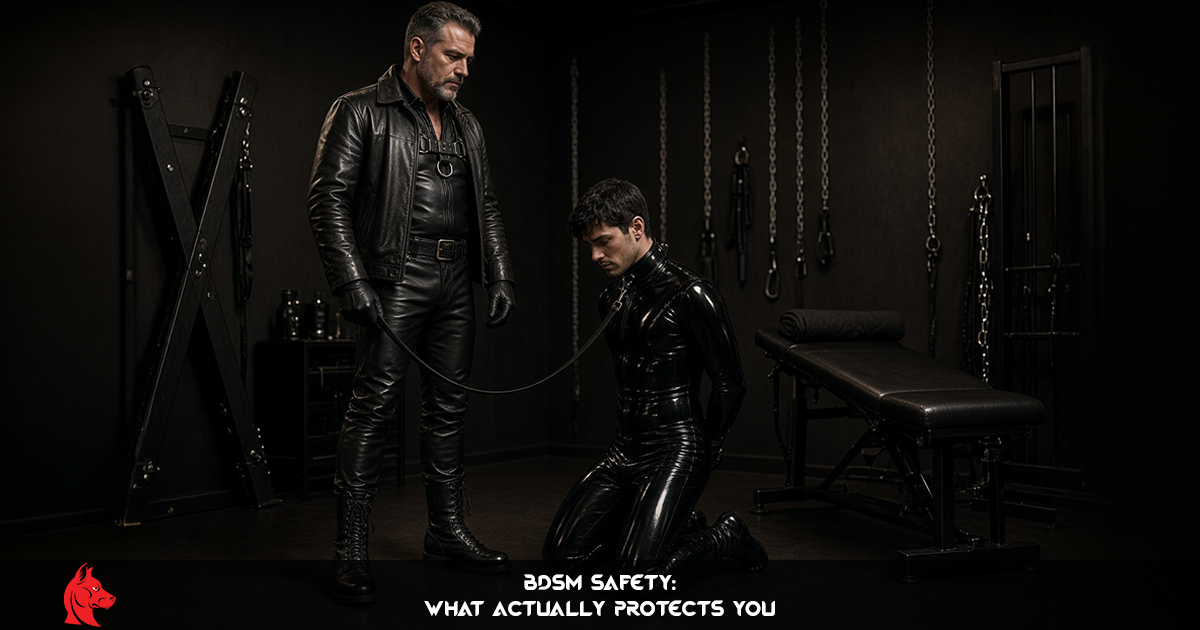
BDSM safety gets talked about as if it were one thing. It is really three, and they fail in different ways. There is the part that happens in conversation before anyone touches anyone. There is the part that keeps a body intact during a scene. And there is the part that stops an infection, which has changed more in the last ten years than in the thirty before it.
Most BDSM safety advice circulating online covers the first, gestures at the second, and is badly out of date on the third.
BDSM safety starts long before anyone is tied up
Consent is not a formality, it is the definition
Everything under the BDSM heading, from a joke spanking to the hardest end of the spectrum, shares exactly one thing: everyone involved agreed to it, whatever role they play. Imposing anything on someone who has not agreed is not BDSM, it is assault, and no amount of scene vocabulary changes that.
That is why BDSM safety begins with a conversation nobody finds sexy. What is on the table, what is absolutely not, what has to be checked first. Agreements can be tacit, spoken or written down, and the more that is new between you, the more explicit they should be.
Limits, and the word that stops everything
Partners have to settle the limits together and then hold them. A word or a gesture agreed in advance, which lets the person receiving stop the scene instantly, is not an optional refinement. It is a fundamental of BDSM safety, and the safeword has its own page here for that reason. Anyone who tells you that needing one makes you less serious has just disqualified himself.
The body: where things actually go wrong
Rope and restraint
Rope is where BDSM safety stops being a conversation and becomes physical. The two real dangers with restraint are circulation and nerves, and neither announces itself with pain. Numbness, pins and needles or a hand that will not grip are reasons to release immediately, not to push through. Whatever holds someone has to come off faster than it went on, which means safety scissors within reach, and a bound person is never left alone in a room, not for two minutes, not to answer the door.
Impact play
Impact belongs on padded, muscled areas. Away from the spine, the kidneys, the joints and the head. Building intensity gradually is not timidity, it is how the person receiving keeps the ability to tell you something is wrong before damage is done.
Breath play is the one to skip
This is the single practice where BDSM safety cannot really be delivered, and it deserves to be said plainly. Restricting blood or air to the brain does its damage below the level anyone can feel. Research teams at Indiana University have been measuring the consequences: a 2023 whole-brain morphometry study published in Brain and Behavior found structural differences in the brains of young adults frequently choked during sex, and later work from the same group found blood biomarkers of neural injury after recent, frequent exposure. Those studies were conducted in young women and are not the last word, but they point the same way as decades of data on non-fatal strangulation elsewhere. There is no technique that makes this safe, only techniques that make it feel controlled.
The infection side has changed completely
U=U is settled, not a slogan
The PARTNER study followed 782 serodifferent gay couples across 14 European countries. During the eligible follow-up, they reported condomless anal sex 76,088 times while the HIV-positive partner was virally suppressed. Fifteen men acquired HIV over that period, and genetic analysis showed that not one of those infections came from within the couple. Undetectable really does mean untransmittable, and the finding was published in The Lancet in 2019.
PrEP and doxyPEP
PrEP protects the HIV-negative side of the equation, and it has its own page here. The newer tool is doxyPEP. In its 2024 clinical guidelines, the CDC recommends that men who have sex with men and transgender women who have had a bacterial STI in the past twelve months be offered 200 mg of doxycycline to take within 72 hours of oral, anal or vaginal sex. Across three randomised trials it cut syphilis and chlamydia by more than 70%, and gonorrhoea by roughly half.
Two honest caveats the CDC states itself. Gonorrhoea results were much weaker where tetracycline resistance is common, which includes France. And resistance effects need watching, which is why it comes with testing every three to six months rather than instead of it.
Vaccines, testing and the rest of the kit
Modern BDSM safety works in layers, each one covering what the others miss. Vaccination against hepatitis A and B, HPV and mpox does work that no barrier can. Regular testing at every site of exposure, not just one, is what catches the infections that have no symptoms. Condoms and gloves still matter, toys are personal or they get a fresh condom for each person, and anything going anywhere near a rectum needs proper lubricant, generously.
Substances change the arithmetic
Alcohol and drugs do not make a scene more intense, they make consent unreliable and pain unreadable. The person who cannot feel a rope biting is the person who gets the nerve injury, and someone too far gone to use the safeword no longer has one. If chemsex is part of the picture, the harm reduction rules around it apply on top of everything above, not instead of it.
Aftercare belongs to BDSM safety too
A scene is not over when the gear comes off. Water, warmth, a check that the person can walk and knows where they are, and a message the next day. This runs both ways: the person who ran the scene takes the comedown too, which is covered on the page about handler aftercare.
When it is no longer BDSM safety, but something else
One caveat to close on. If limits get renegotiated only under pressure, if the safeword is treated as an insult, if photos or money enter the conversation without agreement, or if leaving is made to feel impossible, none of the above applies any more. That is coercion wearing kink as a costume.
Nothing here replaces a doctor or a sexual health clinic, and prevention guidance moves. If something hurts in the wrong way, if numbness lingers after a scene, or if you have had a possible exposure, the right move is a professional and the right window is hours, not weeks.
For comments or projects, please contact me.