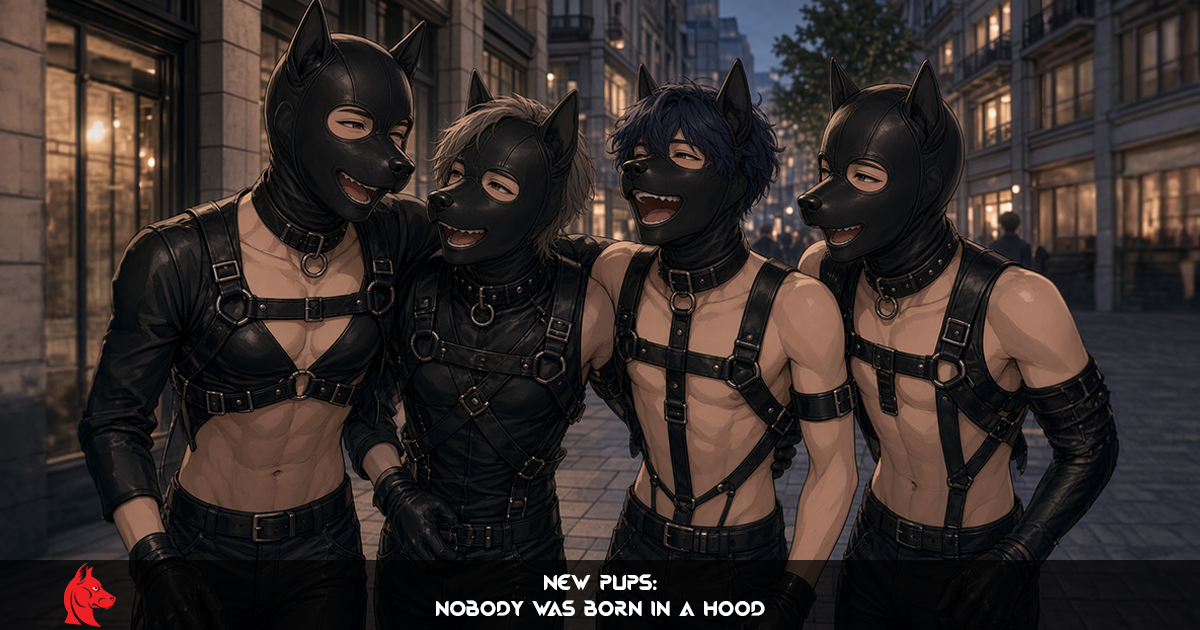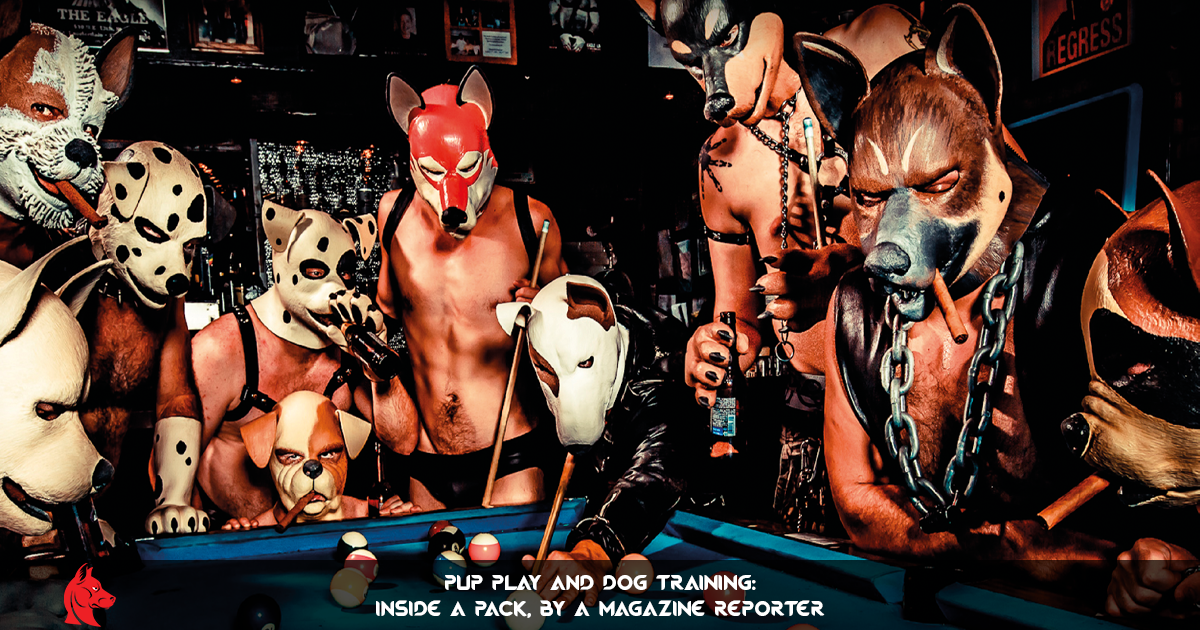
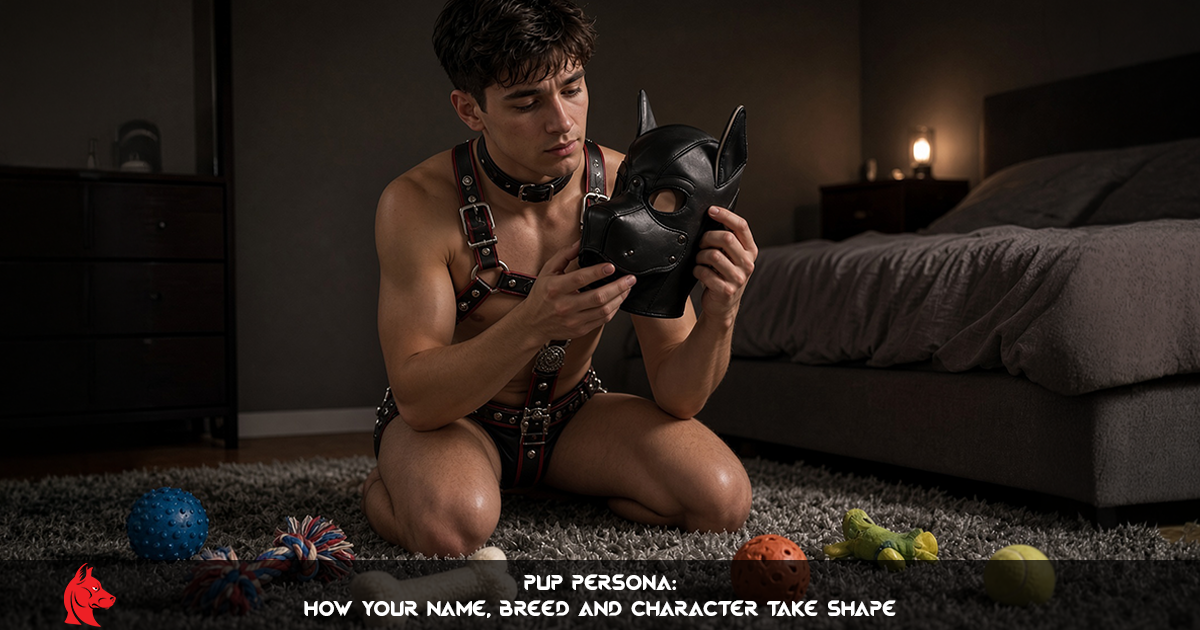
Pup persona is the part of pup play nobody sells you in a shop. Hoods, collars and tails are easy to buy. The character that goes inside them is not, and it is the part that actually makes someone recognisable in a room full of people on four legs.
This article looks at where pup names come from, what a breed really describes, how a personality assembles itself over months rather than minutes, and what researchers found when they asked pups about it directly.
What a pup persona actually is
A pup persona is not a costume, and not a turn performed for an audience. It is a second self you step into, with its own name, its own energy and often its own way of relating to people.
The distinction matters more than it sounds. In a 2019 study published in Archives of Sexual Behavior, Darren Langdridge and Jamie Lawson collected 68 written accounts and 25 interviews from pups across Europe and North America. Their participants drew a hard line between imitating a dog and genuinely dropping into the role. Without that shift, one of them said, you are “just a person with a mask on”.
It gets built, not declared
Newcomers often expect to sit down, decide who their pup is, and be finished by the evening. Almost nobody works that way. The character tends to arrive in pieces: a nickname somebody else uses first, a habit you notice you always fall into, one toy you keep going back to.
Treat the early months as observation rather than design. The job is to find out who you already are on four legs, not to invent someone from nothing.
Choosing a pup name
The name is usually the first fixed piece of a pup persona, and it is close to universal. In a 2022 community survey of 733 pup play participants, also published in Archives of Sexual Behavior, 86.7% had chosen a pup name.
Where names come from
Three routes are common. Some pups pick their own, usually something short and easy to shout across a room. Some are named by a handler or by their pack, which carries real weight in the community because it marks belonging. And plenty end up with a nickname that stuck by accident, which is how a surprising number of the good ones happen.
Nothing says the name has to sound canine. Some pups go by something that would look at home on a metal tag, others by a word with no connection to dogs at all. Both are ordinary.
Practical points worth knowing
Say it out loud before committing to it. A name that will be called across a busy event has to survive noise, accents and a hood over the ears. Two syllables usually beat five.
Check it is not already in use in your local scene, and do not agonise over the decision. Names get changed, and nobody holds an early one against anyone.
Picking a breed, or not
Breed is the piece of a pup persona that beginners overthink most. Just over half of the respondents in that 2022 survey, 54.8%, identified with a specific breed, which also means that nearly half did not. Skipping it is a perfectly normal choice.
Breed describes energy, not looks
The key point: a breed is shorthand for temperament, not a description of a body. A tall, broad man can be a Jack Russell if that frantic, nose-into-everything energy is what comes out when he plays. Nobody in the scene checks anyone’s height against a kennel club standard.
The useful question is what you are actually like in the role. The pup who never sits still, the one who plants himself against a leg and stays there, the one who watches the door: those are three different animals. Pick the breed that matches, if you want one. Mutts are extremely well represented.
Building the personality
Name and breed are scaffolding. The personality is where a pup persona actually lives, and it is built from small decisions rather than grand ones.
Age, energy and quirks
How old is your pup, roughly? A six-month-old and a settled adult behave nothing alike. Loud or quiet? Sociable, or fixed on one person? Obedient, or the sort that hears a command and visibly thinks about it first?
Quirks do more work than any of that. A pup who always carries the same toy, who cannot leave a shoelace alone, or who sighs theatrically when told to lie down becomes recognisable within minutes. That is what people remember, far more than gear.
Pack roles are shorthand, not a caste
Alpha, beta and omega get used to describe how pups sit in a group: alphas leading, omegas soft and service-minded, betas somewhere in between. These are descriptive labels, not ranks awarded for life. Pups move between them depending on the pack and the night, and a good number reject the vocabulary altogether.
How a pup persona changes over time
It rarely stays still
Langdridge and Lawson describe the headspace as a move away from verbal, reflective thinking towards something immediate and instinctive. What surfaces in that state is not always what was planned. A pup persona drifts accordingly, and the drift is a sign it is real rather than performed.
When it leaks the other way
One of the more striking findings in that research is that the traffic runs in both directions. Participants described qualities from the role, confidence and resilience among them, carrying back into their human lives. Several framed their pup self as holding strengths their human self did not have.
That is worth knowing at the start, because it reframes the whole exercise. A pup persona is less a character sheet than a door into parts of yourself that ordinary adult life leaves very little room for.
Three mistakes worth avoiding
Do not copy someone. Borrowing another pup’s identity wholesale is the fastest route to feeling like a fraud, and the scene notices.
Do not buy your way in. Gear is a tool, and an expensive hood will not tell anyone who they are underneath it.
And do not lock your pup persona down too early. The pups who seem most themselves are usually the ones who allowed it a year.
Sources: Langdridge D., Lawson J., The Psychology of Puppy Play: A Phenomenological Investigation, Archives of Sexual Behavior, 2019 (68 written accounts, 25 interviews) ; Wignall L., McCormack M., Cook T., Jaspal R., Findings From a Community Survey of Individuals Who Engage in Pup Play, Archives of Sexual Behavior, 2022 (733 participants) ; Wignall L., McCormack M., An Exploratory Study of a New Kink Activity: “Pup Play”, Archives of Sexual Behavior, 2017 ; Wignall L., Kinky in the Digital Age, Oxford University Press, 2022.
For comments or projects, please contact me.