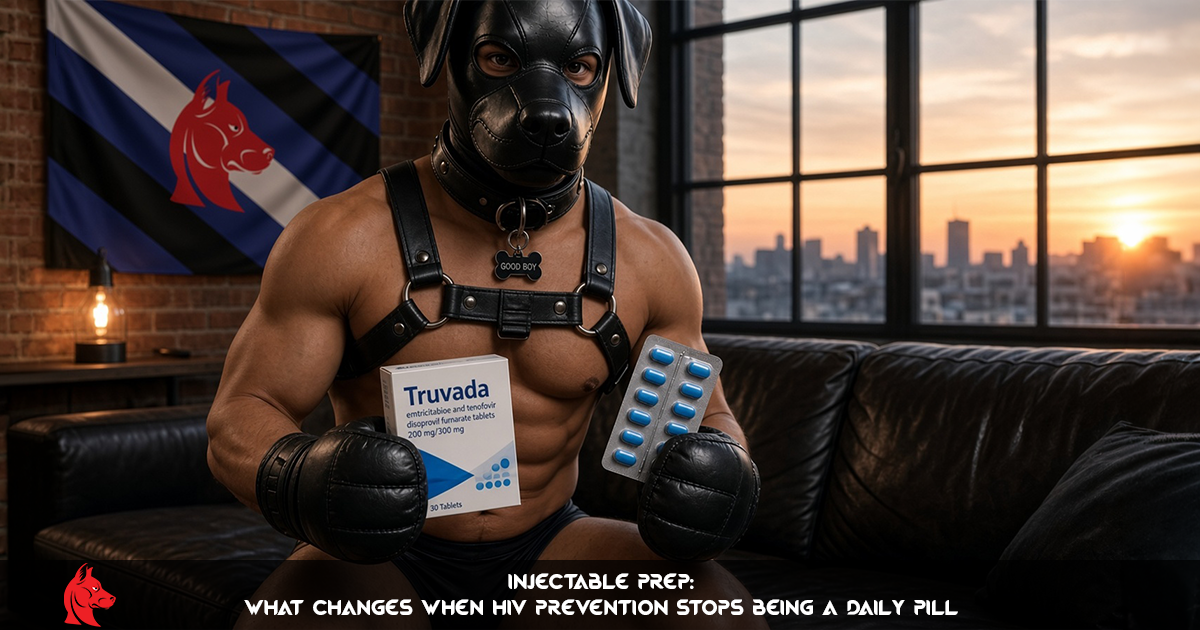
Injectable PrEP has quietly done something the daily pill never managed: it removed the thing people actually fail at. The medication was never the weak part of oral PrEP. Remembering it was. Two long-acting products are now approved, running on two different rhythms, and the phase 3 results behind them are among the strongest in HIV prevention. They also come with a trade-off that is rarely explained properly, and it deserves the second half of this article.
What injectable PrEP actually is
Two products, two rhythms
Cabotegravir is injected every two months. Lenacapavir is injected every six, as two subcutaneous injections into the abdomen or the front of the thigh, preceded by two days of oral tablets: 927 mg by injection plus 600 mg orally on day one, then 600 mg orally on day two. After that, one appointment every 26 weeks, with a two-week margin either side.
Both replace a tablet taken every day, or the on-demand 2-1-1 schedule, with a fixed calendar. That is the entire proposition of injectable PrEP: fewer decisions, and none of them made in the moment.
Where the approvals stand
Lenacapavir was approved by the FDA in June 2025 as Yeztugo. The European Commission authorised it in August 2025 under the name Yeytuo, valid across all 27 EU member states plus Norway, Iceland and Liechtenstein, which includes Spain. The World Health Organization recommended it in July 2025 as an additional prevention option. The US Centers for Disease Control and Prevention has since made it a strongly recommended option in its own guidance. Approval and availability are not the same thing, and what a given country’s health service actually funds is a separate question from what its regulator has authorised.
What the phase 3 trials found
Lenacapavir in PURPOSE 2 and PURPOSE 1
PURPOSE 2 enrolled 3,265 men and gender-diverse people. There were two HIV infections in the lenacapavir group against nine on daily oral F/TDF, an incidence of 0.10 per 100 person-years against 0.93, and an incidence rate ratio of 0.04 against a background incidence of 2.37. In plain terms, 96% fewer infections than expected without prevention, and 89% more effective than daily oral Truvada in the same trial.
PURPOSE 1, run in South Africa and Uganda among 5,338 adolescent girls and young women, recorded zero infections among the 2,134 participants on lenacapavir, against 39 on F/TAF and 16 on F/TDF. A zero in a trial that size is unusual enough to be worth stating plainly.
Cabotegravir in HPTN 083
The older of the two injectables was tested in 4,566 cisgender men and transgender women. Cabotegravir every eight weeks produced 13 infections against 39 on daily oral TDF-FTC, a hazard ratio of 0.34. Less spectacular than lenacapavir, still clearly better than the pill as people actually took it.
The pill was never the weak part
Four in ten stop within six months
A global systematic review of 59 studies covering 43,917 participants found that 41.0% discontinued oral PrEP within six months, with suboptimal adherence in 37.7% over the same period. Just under half, 47.3%, restarted within a year. The confidence intervals are wide, which the authors acknowledge, but the pattern holds across regions.
That statistic is the whole argument for injectable PrEP. It is not that the injection is a better drug. It is that a drug taken twice a year is a drug people are still on in month seven.
Where this bites hardest
Long sessions, weekends away, chemsex, travel, anything that breaks a daily routine, all of it works against a pill and does nothing to an injection given in a clinic in March. For anyone whose sex life is concentrated into events rather than spread evenly across the calendar, injectable PrEP removes the failure mode that matters most.
What injectable PrEP costs in practice
Injection site reactions
A nodule can form where the injection goes in, along with pain, swelling, redness or itching. These are usually mild and settle within days, and they become less frequent with later injections, though some severe reactions have been reported and have been linked to poor injection technique. An ice pack before and after helps. This is the most common reason people give up on the injections, and it is worth knowing before the first appointment rather than after it.
The appointments do not disappear
Nothing about injectable PrEP removes the follow-up. Every continuation visit includes an HIV antigen/antibody test and STI screening by the appropriate route: throat, rectum, urine or blood. Miss the window by more than 28 weeks and oral lenacapavir has to bridge the gap. Two clinic visits a year is still two clinic visits a year, and skipping them is not an option the schedule tolerates.
The tail, and the question nobody explains
Eighteen months of decline
This is the part that gets left out. When lenacapavir is stopped, protective levels are gone after six months, but the drug itself keeps declining in the body for around eighteen months after that point. That long, unprotective tail is not a detail. Anyone stopping injectable PrEP needs another prevention plan starting at month six, not at month twenty-four, and that conversation belongs in the appointment where the decision is made.
Why the HIV test before the first shot is not a formality
Resistance to lenacapavir is rare, but it is real and it has a specific mechanism. In the resistance analysis of both trials, both participants who acquired HIV on lenacapavir in PURPOSE 2 developed the N74D capsid mutation, as did four of the eight participants who turned out to have had an undetected infection when they started. Starting a long-acting injectable during an undiagnosed acute infection is effectively monotherapy against a live virus. That is why the test before the first injection is the one step in the protocol nobody should be casual about.
What injectable PrEP does not cover
Every other STI
Injectable PrEP does nothing about syphilis, gonorrhoea, chlamydia, hepatitis or mpox. It is HIV prevention and only HIV prevention. Everything the site’s page on regular screening covers still applies, vaccination still applies, and barriers still have their place, which is why the practical detail in how condoms actually fail is worth reading alongside this. The same goes for oral sex, covered in the site’s page on risk during suck.
When to talk to a doctor
Nobody starts injectable PrEP alone. It requires a negative HIV test, a prescriber, and a follow-up schedule, and it interacts with certain medications including some enzyme inducers. Two situations deserve a same-week appointment rather than a forum: any symptom of acute HIV infection in the weeks after starting, and any injection site reaction that is severe or does not settle. And if the plan is to stop, say so at the visit rather than by not turning up, because the tail makes silent discontinuation the worst version of that decision.
Injectable PrEP is the biggest practical change in HIV prevention since the pill itself. It is also not a free pass, and the trade-offs are specific rather than vague: reactions at the injection site, two visits a year that still have to happen, a long tail after stopping, and nothing at all against the other infections. Knowing those four things is what makes the choice an informed one.