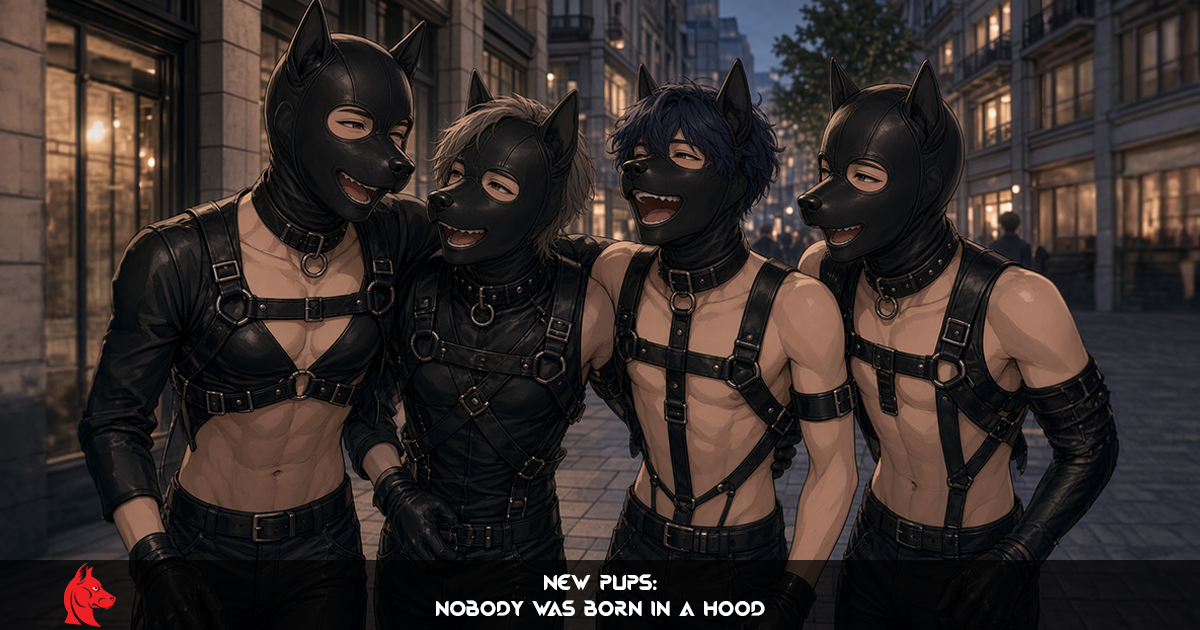
New pups turn up with the same three worries every time. That they will do it wrong. That they will be quizzed on things nobody told them. That someone will decide they are not really a pup at all. None of those worries are about gear, or technique, or anything that can be bought.
The pup scene has a good reputation for being one of the friendlier corners of kink, and it is largely deserved. But friendliness that only extends to people who already know the codes is not the same thing as being open, and the difference matters most to the person standing at the edge of the room.
Where new pups actually come from now
The door moved online
Most people no longer find pup play through a bar or a mentor. Liam Wignall interviewed 26 gay and bisexual men who identify as pups for a 2017 study in Sociological Research Online, and Twitter came out as the central mechanism by which they communicated with each other. One participant said flatly that Twitter was his primary exploration of pup play. Another described the appeal as seeing everyone available to help you or offer advice.
The platforms have shifted since, but the pattern has not: for most new pups the first contact happens on a screen, among strangers, often years before anyone puts on a hood. Whoever answers that first message is the scene, as far as that person is concerned.
Welcoming, but homogenous
The same study contains a warning worth taking seriously. Wignall describes the online pup community as welcoming to new members, and in the same breath as homogenous. His participants were all white gay and bisexual men aged 18 to 35, with an average age of 23.7, which reflects both who was studied and who was visible.
That combination is the specific trap. A group can be genuinely warm and still, without any hostile intent, only be warm to people who look and sound like it already does. New pups who do not fit the picture, because of age, body, colour, gender or simply because they are shy, get a politeness that never turns into an invitation.
What turning people away actually costs
There are more people at the door than in the room
In a community survey of 733 pup play practitioners published in the Archives of Sexual Behavior in 2022, Wignall, McCormack, Cook and Jaspal found that 29.74% belonged to a pack. Of those who did not, 42.91% said they wanted to join one and a further 45.05% said maybe.
Read that again: the number of people waiting outside is larger than the number inside. Every pack that treats its door as a filter is choosing from an enormous queue it never sees.
This is not a hobby people can take or leave
In the same survey, 84.04% said pup play improved their mental health, and 49% reported a mental health diagnosis. These are self-reported figures from people recruited through pup networks, so they describe the committed end of the community rather than everyone, and the authors say so. Even read cautiously, they point at something real: for a lot of people this is not a weekend hobby, it is where they are least alone. Being turned away from it is not a small thing.
What welcoming new pups actually looks like
Answer the question that was asked
Someone asking where to buy a first collar wants to know where to buy a first collar. They do not want a lecture on headspace, a list of what real pups do, or a story about how things were before the internet. The shortest useful answer builds more goodwill than the most complete one.
Gear is not the entry ticket
Kit is close to universal in the community, with 90.9% of the 2022 respondents owning some, and it is also expensive. Hoods and harnesses add up to serious money, which quietly sorts new pups by income before anything else does. A collar and a willingness to play is a complete starter kit, and anyone implying otherwise is describing their own shopping, not the activity.
Introduce, don’t test
The quiz is what drives new pups out fastest. What breed are you, who is your handler, how long have you been a pup, do you know so-and-so. Every one of those questions has a right answer that the newcomer does not have yet. Introducing them to two people by name does more in five seconds than an hour of vetting.
Let them arrive as themselves
New pups do not need to be shaped into the pack’s idea of a pup. Working out a personality, a breed and a name is the interesting part, and it belongs to them. There is a whole article on this site about how a pup persona takes shape, and none of it happens on somebody else’s schedule.
What new pups need to hear
You do not need a name on day one
Of the 2022 respondents, 86.71% of pups had a pup name, and 61.03% chose it themselves, against 22.36% who were given one by a handler or partner. So a name is normal, self-chosen is the majority route, and there is no waiting period and no ceremony required. It can also change later, and often does.
Nobody owns the definition
Every few months someone announces the real rules of pup play, usually with a list. Those lists describe how that person plays and nothing more. The practical test is simpler: what is negotiated, consensual and wanted by everybody involved is legitimate, whatever it looks like from outside. Practical starting points, if you want them, are on the page about how to begin safely and confidently.
When a welcome is not a welcome
One caveat, and it matters more for new pups than for anyone else. A person who offers to teach you, then requires that you speak to nobody else, asks for photos before meeting, tells you a real pup would not need a safeword, or explains that obedience to him is how you learn, is not mentoring you. That is grooming with a leash on it, and being new is exactly what makes it hard to spot.
Anyone worth learning from is happy for you to talk to other people, expects you to negotiate, and treats a safeword as basic equipment rather than an insult. Nobody has to earn the right to those things. They come first, on day one, before any of the rest of it.
The scene is only as good as its front door
Every group that has been shut out somewhere else knows exactly how it feels, and every group is capable of doing it to somebody smaller. The pup scene did not build itself out of rules and credentials. It was built by people who were once new, standing next to other people who were once new, at a point when nobody was checking anyone’s qualifications.
That is the whole inheritance, and it only survives if it keeps being handed on.
Sources: Wignall L., The Sexual Use of a Social Networking Site: The Case of Pup Twitter, Sociological Research Online, 22(3), 2017, 21-37 ; Wignall L., McCormack M., Cook T., Jaspal R., Findings From a Community Survey of Individuals Who Engage in Pup Play, Archives of Sexual Behavior, 51, 2022, 3637-3650 ; Wignall L., McCormack M., An Exploratory Study of a New Kink Activity: “Pup Play”, Archives of Sexual Behavior, 46, 2017, 801-811 ; Wignall L., Kinky in the Digital Age: Gay Men’s Subcultures and Social Identities, Oxford University Press, 2022.
For comments or projects, please contact me.