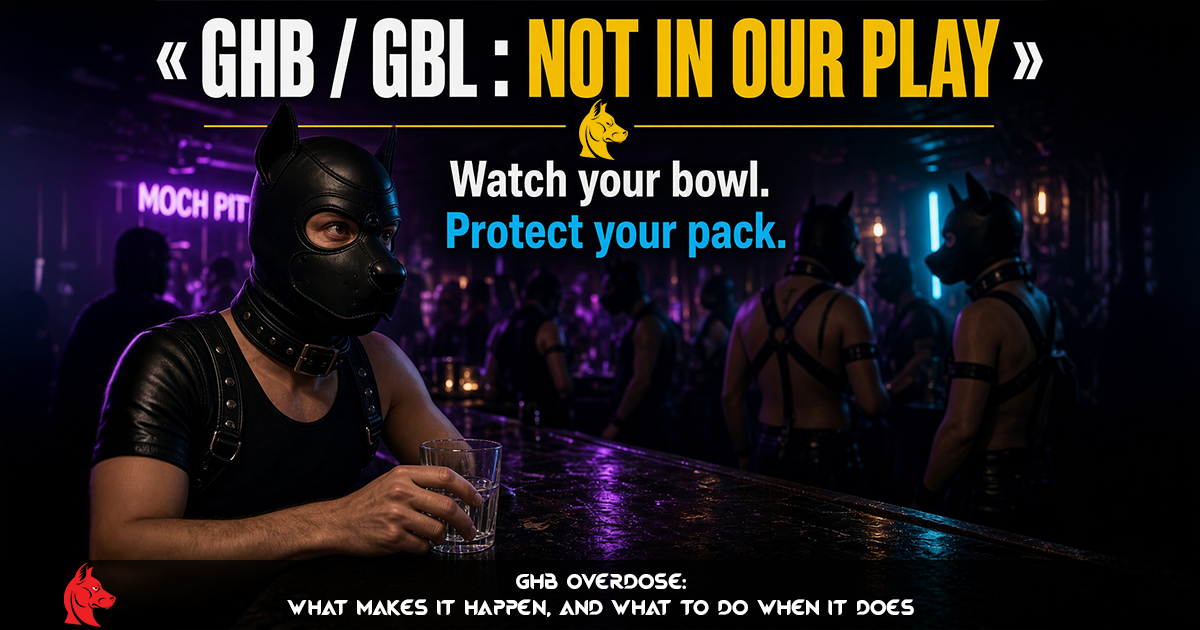
GHB overdose is the reason this page existed in the first place. It carried a French prevention campaign from ENIPSE, a few lines of warnings on a black background, and it has been read more than fifteen hundred times. The advice on it was sound. What it never explained was the mechanism: why a dose that was fine last weekend puts someone on the floor tonight, and what to actually do in the ten minutes that follow. That is what this version is for. It is not a guide to using anything, and there is no version of this that ends with a safe dose.
What GHB and GBL actually are
Two products, one effect
GHB was developed as an anaesthetic. GBL is an industrial solvent, sold as a cleaning product, and the body converts it into GHB within minutes of swallowing it. So does 1,4-butanediol. Three names, one substance once it is inside you, which is why a GHB overdose looks exactly the same whichever of the three was in the bottle.
Why there is no such thing as a safe dose
The published thresholds are close together. Around 10 mg/kg produces sedation and amnesia. Between 20 and 30 mg/kg, people drop into sleep. At roughly 50 mg/kg come bradycardia, respiratory depression and coma. Peak effect arrives 30 to 60 minutes after swallowing, and the whole thing lasts two to four hours.
Read those numbers again and notice how little separates them. Now add the part nobody controls: with GBL, the concentration of the bottle decides everything, and it is never printed on the label. A GHB overdose rarely comes from someone deciding to take far too much. It comes from a measure that was accurate for a different bottle.
The three combinations that cause most of the damage
Alcohol is not one precaution among others
Most of the GHB overdose cases that reach a hospital involve something else as well. Basel University Hospital reviewed 78 GHB-related admissions over fourteen years. Alcohol or another drug was involved in 65% of them. Sixty-eight per cent of those patients arrived in a coma, 10% had to be intubated, and the median time to regain consciousness was 90 minutes. Not a bad night. Ninety minutes of someone else keeping your airway open.
Both substances depress the same thing: breathing. Together they do not add up, they multiply.
HIV protease inhibitors
This is the interaction that deserves more attention than it gets. A 29-year-old man on ritonavir and saquinavir took under 10 mg/kg, a dose at the low end of the scale, and produced the clinical picture normally seen above 50: vomiting, respiratory distress, seizures, coma. He had used the same substances before starting treatment without incident.
Protease inhibitors block the liver enzymes that clear GHB. The dose does not change; what changes is how much of it stays in you. If you are on this kind of treatment, your previous experience tells you nothing useful about your current risk of GHB overdose.
Stimulants
Combining with amphetamines, meth or cocaine raises the risk of seizures, and it hides the early signs of a GHB overdose: the stimulant keeps someone upright and talking while the depressant is still climbing. This is also why giving more stimulants to “wake up” a friend who is going under makes things worse, not better.
What a GHB overdose looks like
The signs
A GHB overdose does not creep up. Sudden heavy drowsiness that comes on in minutes rather than gradually. Vomiting. Slow, shallow or irregular breathing. Twitching or a full seizure. Then the state people call G-sleep, which is not sleep: it is unconsciousness, and someone in it cannot protect their own airway.
There is no antidote
No drug reverses a GHB overdose. Hospital treatment is airway protection and monitoring until the body clears the substance on its own. That is worth knowing before an emergency rather than during one, because it means the only thing that helps in the meantime is someone watching the breathing.
What to do
If he is drowsy but still responds
Keep him awake and keep him watched. Most deaths happen during G-sleep. Move anything he could fall against, and stay with him. Do not give more drugs, do not try to make him vomit, and do not let him “sleep it off” in another room.
If he does not respond
Call emergency services: 112 in Europe, 999 in the UK. If he is breathing, put him in the recovery position so vomit cannot block his airway. If he is not breathing, start CPR. Tell the paramedics exactly what was taken, how much, and when. They are not there to judge anyone, and that information changes what they do.
The consent part nobody says out loud
Someone sliding into unconsciousness has lost the ability to consent. All sexual activity stops there, along with the photos and the filming. This is the same principle that runs through everything else on this site: a body that has stopped answering is not agreeing, whether it is a pup on his back or a friend going under on the sofa. Consent is a conversation, and it ends when one person can no longer take part in it. If that idea is new, the safety basics are a better starting point than any drug page.
Afterwards, and the part that lasts
Dependence creeps up, and stopping alone is dangerous
Regular use builds dependence faster than most people expect, and withdrawal from GHB is not like stopping other substances. It can be life-threatening and last up to fifteen days, running from anxiety, tremor and insomnia through to severe agitation. Nobody should attempt it alone in a flat. That is a medically supervised process.
Where to get help
Nobody plans a GHB overdose, and nobody plans the dependence either. Around 16% of gay and bisexual men in Europe report chemsex, according to a 2024 meta-analysis of eight studies. Whatever your relationship with it, you are not an unusual case, and the services are used to the conversation.
In France, ENIPSE (01 44 59 81 01, enipse.fr) listens, supports and refers, without lectures. In the UK, Terrence Higgins Trust runs chemsex.co.uk, which has the clearest emergency guidance in English. Elsewhere, any sexual health clinic serving gay men will know where to send you. If you want the wider picture on how drugs and sex get combined in this scene.
Something on this page you want to talk through? Contact me.