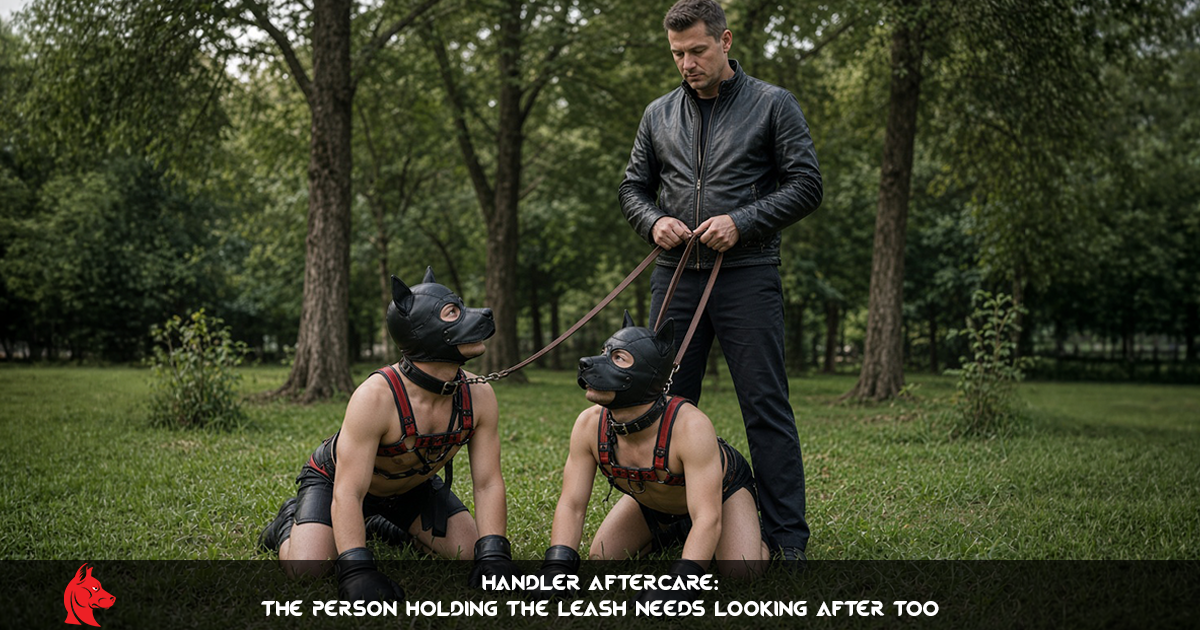
Handler aftercare is the part of a scene almost nobody plans for. The pup gets the blanket, the water, the scratches behind the ear and the quiet ten minutes of coming back up. The handler gets the washing-up, the drive home, and a strange flatness that arrives somewhere around the following Tuesday.
This is not a minor detail of etiquette. Research on what happens after intense kink scenes suggests the comedown is real for the person running the scene as well, and that it does not always arrive when you expect it.
Why handler aftercare gets forgotten
The role does not switch off on its own
A handler spends a session watching. Watching breathing, watching the floor, watching for the moment a pup stops enjoying something and has not yet said so. That attention does not end when the collar comes off, and most handlers keep running it right through the aftercare they are giving.
The result is a strange asymmetry: the person best placed to notice someone struggling is the one person nobody is watching. Handler aftercare has to be built in on purpose, because nothing in the role produces it by itself.
Nobody wants to ask
There is also a cultural reason handler aftercare gets skipped. In parts of the wider BDSM world, a top asking to be looked after still reads to some people as an admission of weakness. The pup scene is generally softer about this than the leather traditions it grew out of, but the reflex survives, and plenty of handlers absorb it without ever examining it.
What actually happens to a handler during a scene
Tops get their own altered state
Handlers are not passive during a scene, and the research bears that out. In a 2017 study published in Psychology of Consciousness, Ambler, Lee, Klement, Sagarin and colleagues randomly assigned fourteen experienced practitioners to top or bottom roles and measured their states afterwards. The two roles did not converge. Tops reported the markers of flow, the state of total absorption in a demanding task first described by Mihaly Csikszentmihalyi, while bottoms reported a very different kind of altered state.
It was a small, preliminary study and deserves to be read as such. But the direction is worth knowing: running a scene is a peak experience in its own right, not the supporting act to somebody else’s. That is the first argument for handler aftercare: you are coming down from something too.
And what goes up comes down
Earlier work by Brad Sagarin and colleagues, published in Archives of Sexual Behavior in 2009, documented hormonal shifts across BDSM scenes and their link to bonding between partners. Whatever the precise mechanism, the practical point is old news to anyone who has ever run an intense session: you cannot hold that level of focus for two hours and then feel entirely normal at eleven at night.
Top drop, and the version that arrives days later
Two different things wear the same name
The most useful thing published on this comes from Richard Sprott and Anna Randall, writing in the Journal of Positive Sexuality in 2016. They looked at what the community calls sub drop, top drop, scene drop and event drop, grouped them as “x-drop”, and made one observation that changes how you handle it: there are two separate phenomena here, not one.
The first is immediate. It arrives at the end of a scene, in minutes, and looks like the exhaustion phase of any acute stress response: shaking, cold, disorientation, a need to sit down. Sleep, food and warmth deal with it.
The second arrives one, two or three days later, and that one is not an exhaustion phase at all. The timing rules it out.
Later drop looks more like grief
Sprott and Randall’s proposal is that the delayed version is a reaction to loss. What has been lost is the peak experience itself: the state of complete absorption, the version of yourself that only exists in that state. A few days on, ordinary life resumes and the contrast lands.
They note that the same pattern is described by actors after a run closes and by athletes after the Olympics, and they are careful to frame it as a healthy process rather than a symptom. Their conclusion is that drop may be a sign of growth rather than a sign that something has gone wrong.
It also explains why handler aftercare cannot be a ten-minute ritual at the end of the night. For a handler, that reframing does real work. Feeling hollow on Wednesday after an excellent Saturday does not mean the scene was bad, that you did something wrong, or that you have a problem.
What handler aftercare looks like in practice
For the handler
Plan your own landing before the scene, not after. Whatever you have arranged for the pup, decide what you get: a meal, a shower, an hour that belongs to nobody else, a message to someone the next day.
Do not drive straight home from an intense session if you can avoid it. Eat something. And put a marker three days out, mentally or in a calendar, so that if the flatness arrives you recognise it rather than diagnosing yourself with something worse.
Handler aftercare also means naming what you need out loud, before you are in the middle of needing it. Nobody in a pup headspace is going to work it out for you.
For the pup
Handler aftercare coming from a pup does not have to be elaborate. Ask. That is most of it.
The answer will usually be “I’m fine”, and that is not a wasted question: your handler now knows somebody is paying attention, which is the point. A message the next day works too. So does a phone call three days later, which is when it is actually most likely to be useful.
If a scene went sideways, ask twice. Handlers carry guilt about that far longer than pups tend to realise, and reassurance from the person who was actually there is worth more than any amount of self-talk.
Asking is not a weakness
The objection to all of this is always the same: it undermines the role. It does not. A handler who knows what a hard session costs them, and who plans for it, is a handler who can keep doing this for years instead of quietly burning out and disappearing from the scene, which happens more than anyone admits.
Handler aftercare is not a favour anyone is doing you. It is basic maintenance on the person everybody else is relying on.
When it is more than drop
One honest caveat. The research here is a theoretical proposal, not settled science, and Sprott and Randall say so plainly. If low mood after sessions is persistent rather than passing, deepening rather than lifting, or turning up without any scene to explain it, that is worth talking to a professional about, ideally a kink-aware one. Drop is normal. Weeks of it is a different conversation.
Sources: Sprott R. A., Randall A., Black and Blues: Sub Drop, Top Drop, Event Drop and Scene Drop, Journal of Positive Sexuality, Vol. 2, November 2016 ; Ambler J. K., Lee E. M., Klement K. R., Sagarin B. J. et al., Consensual BDSM Facilitates Role-Specific Altered States of Consciousness: A Preliminary Study, Psychology of Consciousness: Theory, Research, and Practice, 4(1), 2017, 75-91 ; Sagarin B. J., Cutler B., Cutler N., Lawler-Sagarin K. A., Matuszewich L., Hormonal Changes and Couple Bonding in Consensual Sadomasochistic Activity, Archives of Sexual Behavior, 38, 2009, 186-200 ; Csikszentmihalyi M., Beyond Boredom and Anxiety, Jossey-Bass, 1975.
For comments or projects, please contact me.