
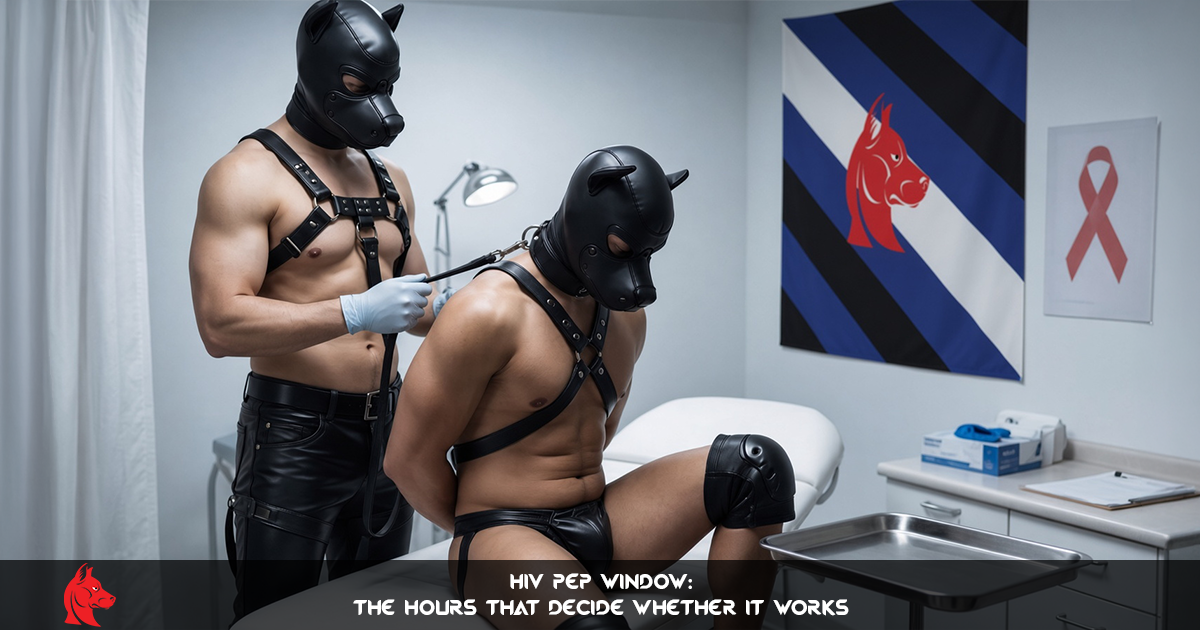
HIV PEP window is the only part of post-exposure prophylaxis that anyone needs to know by heart, because everything else can be sorted out at the clinic and this cannot. The drugs work, but only if they are started early enough, and how early depends on which country’s guidance is being applied. France closes the door at 48 hours. The World Health Organization and the NHS say 72. Both are reading the same evidence, which is worth understanding before finding out the hard way.
What the HIV PEP window really is
Ideally four hours
Every set of guidance agrees on the first number and it is much smaller than most people think. The French Haute Autorité de Santé puts it plainly: treatment should start as early as possible, ideally within 4 hours. The WHO says as soon as possible, ideally within 24 hours. Nobody frames this as a deadline to be met at leisure. The HIV PEP window is a curve, not a switch, and every hour spent deciding costs something.
Where the clock stops depends on the country
The HAS sets the outer limit at 48 hours and states that beyond it, and specifically over the 48 to 72 hour period, the literature shows no significant protection. The WHO and the NHS set it at 72. Same evidence, different call on where to draw a line through it. In practice, anyone who might need the HIV PEP window should assume the shorter figure and move accordingly.
Why the HIV PEP window closes at 48 in France and 72 elsewhere
What the WHO actually says
This divergence looks bigger than it is. The WHO’s own guidance states that taken between 48 and 72 hours after exposure, regardless of how many drugs are used, PEP is much less likely to be effective. That is not a contradiction of the French position, it is the same finding with a different practical conclusion: France stops offering it, the WHO keeps the option open while telling you the odds have dropped.
The evidence underneath is thin, and old
The number everyone quotes traces back to a single case-control study from 1997, in which health workers who took zidovudine after a needlestick had an odds ratio of 0.19 for seroconversion, commonly rendered as an 81% reduction. Thirty-three cases and 665 controls, one drug that nobody uses this way any more, and percutaneous occupational exposure rather than sex. It has never been repeated, because randomising people to no PEP would not pass an ethics committee. Anyone quoting a precise efficacy figure for the HIV PEP window today is quoting that study, and it deserves to be named rather than hidden.
What PEP is, in practice
The regimen and the thirty days
France recommends tenofovir disoproxil with lamivudine or emtricitabine, plus doravirine, as a single daily tablet or two, for 30 days. The WHO’s preferred regimen is tenofovir and lamivudine with dolutegravir, for 28 days. Either way it is a month of daily tablets taken properly, not a morning-after pill, and the HAS notes that no specific blood monitoring is needed during those thirty days.
The bloods must never delay the first dose
This is the operational detail that saves the HIV PEP window in practice. The HAS is explicit that the initial blood work must never hold up treatment: PEP can be started before the tests are done and before the results are back. Anyone told to wait for a laboratory result before the first tablet should say so out loud, because inside this window, waiting is the only real mistake available.
After the treatment: the follow-up calendar
Four, six, ten or twelve weeks
The HIV PEP window governs the start; the follow-up calendar governs when the episode is actually closed. The schedule depends on what happened, and the HAS sets it out case by case. People going straight onto PrEP after PEP are tested at four weeks, at the end of treatment, so the two can be chained without a gap. Without PEP and without hepatitis risk, HIV and STI testing happens at six weeks. With PEP but no PrEP indication and no hepatitis risk, it moves to ten weeks, which is six weeks after the treatment ends. Where there is a hepatitis risk, everything shifts to twelve weeks, so that late hepatitis B and C markers are not missed.
From PEP to PrEP without a gap
The French guidance builds the bridge deliberately. One of the recommended combinations exists precisely so that at the end of the month, dropping the doravirine tablet leaves a person on tenofovir with emtricitabine, which is PrEP. If an exposure was serious enough to justify emptying the HIV PEP window, it is usually worth asking whether continuous prevention makes more sense than repeating the exercise, a question the article on injectable PrEP goes into.
What PEP does not do
Everything that is not HIV
PEP is HIV prophylaxis and nothing else. Syphilis, gonorrhoea, chlamydia and the hepatitis viruses are unaffected by it, which is why the initial work-up includes syphilis serology and gonococcal and chlamydia PCR, and why regular screening and vaccination still carry the load they always did.
It is not a result
Starting PEP is not the same as being in the clear. The exposure is only settled by the follow-up test, which is why barriers matter through that period, and why the practical detail in how condoms actually fail is worth having read before the night it matters. The reverse case is worth knowing too: if the other person is on treatment with an undetectable viral load, there is no HIV exposure to treat.
When to go, and when to talk to a doctor
What actually justifies it
Receptive or insertive anal sex without a condom with a partner of unknown or positive untreated status, a condom that broke during anal sex, blood contact with mucous membranes, and any doubt about whether PrEP or a partner’s treatment was actually working. Sharing needles belongs on the list as well. None of these is a judgement call to make alone at three in the morning. The decision to open the HIV PEP window is made at the clinic, not by the person on the way there, and turning up to be told no costs far less than not turning up.
The conversation worth having
Emergency departments and sexual health clinics dispense PEP, and out of hours the emergency department is the answer rather than waiting for Monday. Beyond the acute episode, two things deserve a proper appointment: whether continuous prevention should replace repeated emergency treatment, and, if exposures cluster around sessions where substances are involved, that pattern itself, which is better discussed with a clinician who understands kink and chemsex than left to sort itself out.
Everything else in HIV prevention can be planned calmly. This cannot, and that is the only reason it needs to be known in advance: not the drug names, not the follow-up weeks, just the fact that the HIV PEP window is measured in hours and that the shortest reading of it is 48. Knowing that before it matters is what makes the difference between a phone call and a diagnosis.